Coding Window Hours in Metro Manila: Complete 2026 Guide
The term coding window hours describes the times when the number coding system in Metro Manila stops operating to allow coded vehicles to drive freely on main roads. In many cities window hours between 10:00 AM and 5:00 PM are implemented but its enforcement varies across different local government units.
According to the Metropolitan Manila Development Authority (MMDA) report, it has about 2.5 million registered private vehicles. The average weekday produces 500,000 coded vehicles because window hours create a system that drivers must learn to avoid fines and save time.
In this guide you will have all important information to understand coding window hours in Metro Manila, which includes the most current 2026 schedules for Quezon City, Makati, Pasig, Pasay, and other NCR cities. The schedule will show you when you can drive your coded vehicle, which areas have no window hours, and how to legally navigate Metro Manila during your coding day.
Coding Window Hours and How Do They Work
Basically, coding window hours are time gaps during the day when the MMDA number coding scheme Metro Manila is not enforced, that is from 10:00 AM to 5:00 PM on weekdays. During these hours, you can drive legally with your coded plate numbers on major Philippines roads without facing any penalties or apprehension by the LTO.
The Unified Vehicular Volume Reduction Program (UVVRP) which is also called number coding. According to this program vehicle owners are restricted to follow driving restrictions which depend on their last license plate digit. There are two specific ending numbers that remain prohibited to enter major roads during both morning and evening peak traffic times which occur on weekdays.
There are two main schedules for coding hours.
- If you are in Metro Manila , your schedule coding hours start from 7:00 AM to 10:00 AM and from 5:00 PM to 8:00 PM.
- On the other hand, in most cities you can drive your vehicles anywhere between 10:00 AM and 5:00 PM, which means that the time period between 10:00 AM and 5:00 PM is your available driving time.
But you can not follow the same schedule in every city. Because Makati City enforces continuous coding from 7:00 AM to 7:00 PM with zero window hours and Manila City recently followed suit. Other areas like Pasay and parts of Taguig have modified rules depending on which road you’re using.
What Time Is Coding in Metro Manila?
If you are in Manila and want to check the coding, you have to look at your vehicle’s plate number and pick the last digit of your plate number and match it with the schedule below. For your ease we have shared the weekdays schedule along with the end digits of the plate numbers.
| Day | Last Digit of Plate Number |
|---|---|
| Monday | 12 |
| Tuesday | 34 |
| Wednesday | 56 |
| Thursday | 78 |
| Friday | 90 |
| Saturday | No Coding |
| Sunday | No Coding |
If you’re trying to make your way between Makati and Manila, the coding hours would be between 7 in the morning to 10 in the morning, and 5 p.m through to 8 p.m.
If you need to upload your plate number in LTO or update your records, do this before your coding day to make sure that your vehicle information is accurate in all MMDA databases.
MMDA Number Coding Scheme Metro Manila
As we told you above that the vehicles are restricted based on their last digits of the plate number so according to the 2026 MMDA number coding today schedule vehicles are restricted Monday through Friday based on plate number endings, such as 1 & 2 on Monday, 3 & 4 on Tuesday, 5 & 6 on Wednesday, 7 & 8 on Thursday, and 9 & 0 on Friday. On weekends and national holidays your vehicles are coding-free across all Metro Manila cities.
MMDA Number Coding Schedule 2026
| Day | Plate Ending | Standard Coding Hours | Window Hours |
|---|---|---|---|
| Monday | 12 | 7:00 AM – 10:00 AM5:00 PM – 8:00 PM | 10:00 AM – 5:00 PM |
| Tuesday | 34 | 7:00 AM – 10:00 AM5:00 PM – 8:00 PM | 10:00 AM – 5:00 PM |
| Wednesday | 56 | 7:00 AM – 10:00 AM5:00 PM – 8:00 PM | 10:00 AM – 5:00 PM |
| Thursday | 78 | 7:00 AM – 10:00 AM5:00 PM – 8:00 PM | 10:00 AM – 5:00 PM |
| Friday | 90 | 7:00 AM – 10:00 AM5:00 PM – 8:00 PM | 10:00 AM – 5:00 PM |
| Saturday | None | No Coding | All Day |
| Sunday | None | No Coding | All Day |
The driving restrictions for major roads on Tuesday apply from 7:00 AM to 10:00 AM and from 5:00 PM to 8:00 PM for drivers whose plate ends at 3. The driving restrictions for major roads between 10:00 AM and 5:00 PM remain in effect except for your entry into Makati or Manila City proper.
City-by-City Coding Window Hours in Metro Manila
The Metro Manila cities including Quezon City, Pasig, Mandaluyong, San Juan, Caloocan, and Valenzuela, follow the window hours 10:00 AM to 5:00 PM. However, Makati City and Manila City enforce continuous coding with no window hours at all.
The following section presents the coding hours for each city.
Coding Window Hours Quezon City
If you are in Quezon City, you have to follow the standard MMDA schedule.
| Coding hours in Quezon City: | 7:00 AM to 10:00 AM & 5:00 PM to 8:00 PM. |
| Window hours: | 10:00 AM to 5:00 PM. |
The implementation of this law governs Commonwealth Avenue EDSA which runs through QC limits and Quezon Avenue and España Boulevard.
Enforcement is active but not as strict as Makati. You can check your LTO plate tracker to confirm your vehicle registration status and coding day.
Makati Window Hours
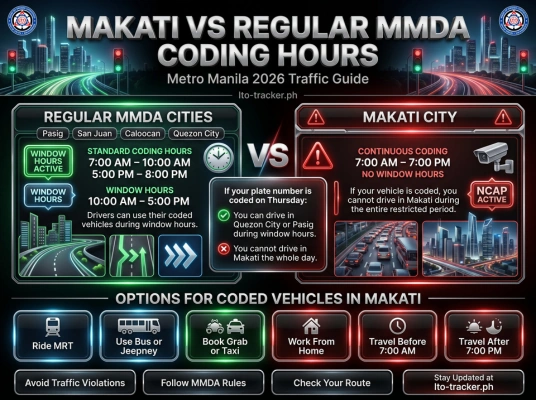
For Makati residents there are no window hours. They have continuous coding hours;
Their coding hours: 7:00 a.m. to 7:00 p.m.
The day you are ready to code is if it is Monday and is 1 or 2 (the plate number that makes it odd or even) during 7:00 a.m. to 7:00 p.m. then you cannot enter Makati.
The schedule applies to all major roads such as:
- Ayala Avenue
- Makati Avenue
- EDSA (Makati portion)
- Buendia Avenue &
- Internal streets within the Central Business District.
You will have enforcement strictly with CCTV-based No Contact Apprehension Policy (NCAP) actively issuing tickets.
Pasay Coding Hours
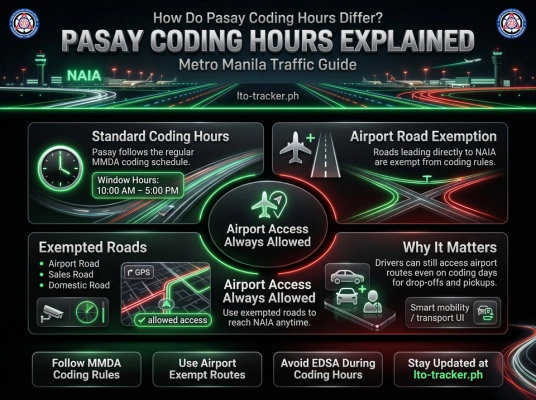
In Pasay, the usual coding window hours are followed. The three roads that access Ninoy Aquino International Airport (NAIA) remain open to traffic because they need to provide free movement for airport travelers which include:
- Airport Road
- Sales Road &
- Domestic Road
This means you can still use these roads on your coding day if you are going to the airport. But you should avoid using EDSA and Roxas Boulevard during restricted hours to prevent penalties.
Coding Hours Manila
In Manila, you now have a continuous coding rule, just like in Makati.
Manila Coding Hours: 7:00 AM to 7:00 PM
Window hours for Manila city: No window hours.
Manila citizens have implementation on major roads which include:
- España Boulevard
- Taft Avenue
- Roxas Boulevard in Manila &
- All streets that surround Divisoria.
You should check the most recent information from the Manila Traffic and Parking Bureau before you travel to Manila. When you check the traffic rules first, you can avoid penalties because rules may change.
Pasig City Window Hour Coding
The city of Pasig uses the standard coding system which the Metropolitan Manila Development Authority established.
The window time: 10:00 AM to 5:00 PM
The window time permits vehicles which follow coding rules to drive on the roads. This regulation applies to major roads, including:
- Ortigas Avenue
- C5 Road &
- Meralco Avenue
You can still use some smaller streets and service roads because they do not follow the coding rule which prohibits driving during your coding day.
Taguig and Parañaque
In Taguig, you have the coding rule for a few main roads which include:
- C5 Road
- East Service Road &
- Manuel L. Quezon Avenue
You will be free from the coding rule on The streets inside Bonifacio Global City (BGC), so you can easily drive there even on your coding day.
In Parañaque, you have coding rules on roads:
- Near the coastal area &
- Those close to the South Luzon Expressway (SLEX).
You have to check your route before traveling to avoid any restrictions.
MMDA Odd-Even Scheme Schedule
During the EDSA rehabilitation project in the Philippines, MMDA decided to reduce the traffic and implement the odd-even schedule instead of the normal number coding schedule. According to the odd-even scheme, vehicles allow or restrict on the road based on their odd or even plate numbers.
The scheme works in the way that on specific days you can drive your vehicles based on the last digit of plate number.
Vehicles with plate numbers ending in 1, 3, 5, 7, and 9 are called odd numbers.
Vehicles with plate numbers ending in 0, 2, 4, 6, and 8 are called even numbers.
Odd-Even Schedule:
| Day | Allowed Plate Numbers |
|---|---|
| Monday | 02468 |
| Tuesday | 13579 |
| Wednesday | 02468 |
| Thursday | 13579 |
| Friday | 02468 |
| Saturday | 13579 |
A few vehicles were exempted from this rule, including:
- Hybrid and electric vehicles
- Motorcycles
- TNVS vehicles like Grab
Firstly, MMDA implemented the odd-even scheme but after President Ferdinand Marcos Jr. The EDSA project was postponed. That’s why the original number coding system is running in Metro Manila now.
Exemptions to the Coding Hours Metro Manila
In some special cases and vehicles, the MMDA number coding scheme provides exemption such as motorcycles, emergency vehicles, government vehicles, electric and hybrid vehicles etc. These exemptions apply 24/7 and you can drive freely even during coding hours.
Here’s you have a full exemption list:
| Vehicle Type | Details |
| Motorcycles and Scooters | All engine sizes are allowed |
| Emergency Vehicles | Ambulances, fire trucks, police, and military vehicles |
| Electric & Hybrid Vehicles | BEV, HEV, and PHEV registered under EVIDA (until April 15, 2030) |
| TNVS (Ride-Hailing Cars) | Must have a valid LTFRB franchise (e.g., Grab) |
| Public Utility Vehicles | Jeepneys, buses, and UV Express vans |
| Perishable Goods Vehicles | Must carry proper documents |
| Medical Professionals | Doctors and health workers with MMDA exemption stickers |
| PWD Vehicles | Vehicles with valid PWD exemption |
| Diplomatic Vehicles | Vehicles with red plates |
Who can Apply for Exemption?
Medical professionals and doctors can submit exemption requests. And if you have a hybrid or electric car, you don’t need to worry about coding. You already have exemptions from the number coding scheme.
Your vehicle documents like your certificate of Registration details represent that it is an electric or hybrid vehicle. This benefit comes from Republic Act 11697, which supports cleaner and greener transportation.
Here’s the complete list of vehicles for which you can apply for special exemption:
| Vehicle Type | Simple Explanation |
| PWD Vehicles | Vehicles used by persons with disabilities (with valid proof) |
| School Buses | Buses for students with proper LTO stickers and markings |
| Company Shuttles | Free transport for employees with official stickers |
| Delivery Vehicles | Vehicles carrying fresh or easily spoiled goods |
| Tourist Vehicles | Vehicles approved by the Department of Tourism for travel use |
| Media Vehicles | Unmarked vehicles used by reporters and media workers |
How to Apply for a Special MMDA Window Hours Coding Exemption?
Steps for exemption application:
First of all you have to write an exemption letter and clearly explain why you need exemption from the number coding system.
Then you need to visit the MMDA Traffic Enforcement Division located at EDSA corner Orense Street, Guadalupe, Makati City and submit your letter request.
In the next step you have to submit your vehicle’s documents (a photocopy of OR (official Receipt) and CR (certificate of registration) along with proof of work.
For PWDs: you have to submit some additional documents including:
Pay the required fee at the Treasury Department (6th floor) of the MMDA building:
Then you will receive an LTO sticker which will be valid for one year and it must be displayed on the windshield.
Cities With Minimal or No Coding
Some cities have partial enforcement:
- Marikina: The coding rule is mainly on Marcos Highway. Usually, you will see that the other roads in the city are not affected.
- Muntinlupa: Coding is mostly enforced on Alabang–Zapote Road.
- Las Piñas and Pateros: Have very limited coding enforcement, so fewer roads are covered.
- Taguig: Coding applies only on major roads like C-5, East Service Road, and Manuel L. Quezon Avenue
- Malabon and Navotas: Traffic-dependent enforcement applies. Coding rules may be applied only when traffic is heavy, so enforcement can change depending on the situation.
Roads and Expressways Where Number Coding Does Not Apply
The following roads are generally exempt from number coding:
- NAIA Expressway
- Skyway
- South Luzon Expressway (SLEX)
- Domestic Road
- Ninoy Aquino Avenue
- MIA Road
- Sales Road
- Some parts of Airport Road
- Parts of Buendia Avenue (Gil Puyat)
- Other toll roads across Metro Manila
How to Check Number Coding Today in Manila?
Manila’s residents also enjoy the weekends without any coding rule, there is no coding applied on Saturdays, Sundays or even national holidays. You are free to drive anywhere in Metro Manila. Not only weekends, MMDA also suspends coding rules during dangerous weather conditions and when strong typhoons and emergencies occur.
For the regular updates you must check the MMDA official Facebook page or Twitter account. They post daily reminders and suspension notices. You can also login to the LTO portal to verify your vehicle’s registration details and make sure that your records are updated.
Difference Between Makati Coding Hours and Regular MMDA Hours
You can see above that Metro Manila’s cities including Pasig, San Juan, or Caloocan follow the normal MMDA coding hours. They also allow “window hours” from 10:00 AM to 5:00 PM, which means you can drive your coded vehicles during that time.
On the other hand Makati is different because it does not have any window hours. If your car is coded, you cannot drive in Makati from 7:00 AM to 7:00 PM.
For example, if your plate number is coded on Thursday, you can drive in Quezon City or Pasig during window hours. But in Makati, your vehicle is not allowed the whole day.
Makati follows stricter rules because the city has heavy traffic from offices, malls, and busy business areas.
If your vehicle is coded and you work in Makati, you can:
- Ride the MRT, bus, or jeepney
- Use Grab or a taxi
- Work from home if allowed
- Travel before 7:00 AM or after 7:00 PM
Some people even buy a second car with a different plate number so they can drive every day without any stress of coding violation.
How Do Pasay Coding Hours Different?
Pasay follows the regular MMDA coding schedule with window hours from 10:00 AM to 5:00 PM.
However, roads going directly to NAIA airport are exempt from coding. This means drivers can still use these airport roads even on their coding day.
Some exempted airport roads include:
- Airport Road
- Sales Road
- Domestic Road
This is helpful for people dropping off or picking up passengers at the airport.
Fines and Penalties for Coding Scheme Window Hours Violations
If you own a private vehicle, you cannot break the number coding rule even during your window hours because coding is temporarily stopped at that time. But if you drive during the restricted hours which are from 7:00 AM to 10:00 AM or 5:00 PM to 8:00 PM, you can get caught and fined ₱300 to ₱500 for each act under the Single Ticketing System.
When you are driving on the road you can be caught by traffic officers and also by MMDA No Contact Apprehension Policy (NCAP) cameras. The MMDA uses automated license plate recognition technology on major roads. If your coded vehicle is detected during restricted hours, you’ll receive a notice of violation via registered mail or SMS if your contact details are updated in LTO records.
You have seven days to settle the fine. Payment options include:
- Landbank LinkBiz Portal (online payment)
- Bayad Center or SM Bills Payment counters
- GCash, Maya, or GrabPay (select billers)
- MMDA Traffic Management Division office in Makati
If you have your unpaid violations for more than 7 days, it will block your vehicle registration renewal. The LTO and MMDA share databases, so any outstanding ticket will appear when you attempt to renew your registration. You must settle all your fines before processing.
If you are not sure about your pending violations or payment, you can check LTO violations or fines online via your plate number or conduction/chassis number.
Check Number Coding Violation fines & Penalities:
If you want to check your coding violation fine, you can visit the official MMDA website and also use the MMDA app.
Steps:
- First of all, open your browser and search for the MMDA official website.
- Then open it and go to the violation inquiry option.
- Provide your vehicle’s plate number.
- The information about your number coding violation will display on your screen.
If you want to verify your vehicle registration status or check if there are any flags on your plate, you can check LTO alarm status to make sure your vehicle has no pending issues that could complicate enforcement.
How to Avoid Number Coding Violations in Metro Manila
You will avoid violations, if you know your coding day. You can plan your trips during window hours (10:00 AM to 5:00 PM), through alternate vehicles or public transport. And you must stay updated on MMDA announcements for suspensions. Your simple planning can eliminate most of the upcoming risks.
Here are practical strategies:
Schedule Important Trips During Window Hours
If you have a medical appointment, client meeting, or important errand, book it between 10:00 AM and 5:00 PM because businesses work during these hours anyway. Due to this! you can drive legally without worrying about apprehension.
Use Navigation Apps With Coding Alerts
Waze and Google Maps integrate MMDA traffic data and can alert you if you’re entering a coding zone. You must enable notifications and check your route before leaving your location. These apps also suggest alternate roads that may have lighter enforcement or exemptions.
Carpool With Colleagues or Neighbors
If you and a coworker live in the same area but have different coding days, arrange a carpool schedule. This reduces the number of vehicles on the road and helps both of you avoid coding restrictions.
Keep an Emergency Transport Fund
You need to set aside a small budget for Grab, taxi, or bus fare on your coding day. When you have ₱500 to ₱1,000 available in your pocket, you will easily manage if an urgent trip comes up during your restricted hours.
Apply for Exemption if Eligible
If you’re a medical professional, PWD, or you have your own electric vehicle, you have to secure your exemption. By exemption you can avoid all coding restrictions and also get relaxation in your daily routine.
Monitor MMDA Social Media Daily
As we have told you above that coding can be suspended due to holidays, typhoons, floods, or special government events. The MMDA announces these suspensions on Facebook and Twitter. So you must follow their official accounts and turn on notifications so you’re always informed.
You should create a recurring event for your coding day and enter it into your phone’s calendar. And you must create an alert which will activate at 6:30 AM to make sure you wake up before your restricted hour departure.
Does the Coding Scheme Actually Reduce Traffic?
The existing number coding system for Metro Manila traffic control operates through ongoing public disagreements about its effectiveness. The government implemented the system in 1995 which provided initial traffic relief through decreased vehicle usage during that period. The street network experienced improved traffic conditions because drivers encountered fewer vehicles during peak travel times.
The rule prohibition became ineffective because families discovered methods to bypass it. Families purchased multiple vehicles displaying different license plates to maintain vehicle operation throughout coding days. The regulation violation resulted in increased vehicle traffic because drivers chose to operate their vehicles without valid operational permits.
MMDA currently states that the number coding system maintains its ability to decrease traffic volume during peak travel times yet its effectiveness remains incomplete. The primary problem exists because people continue to depend on personal vehicles since public transportation systems fail to provide adequate service for all passengers.
Makati’s all-day vehicle restriction system which prevents drivers from using their cars during specific times has gained support from some traffic specialists. The Metropolitan Manila area should prioritize development of train and bus systems while maintaining existing public transportation systems instead of enforcing stricter vehicle coding requirements.