Certificate of Registration LTO Guide 2026
If you own a vehicle in the Philippines, one of the most important documents you will receive is the Certificate of Registration (CR). This document is issued by the Land Transportation Office (LTO) and serves as official proof that your vehicle is properly registered in the government’s records.
Whether you are buying a car, selling a motorcycle, renewing registration, or transferring ownership, the Certificate of Registration is one of the documents you will need.
This guide shows you how to get, track, renew, and replace your LTO certificate of registration. You’ll learn about validity periods, portal access, and exact requirements. Everything you need is here.
What Is a Certificate of Registration from LTO?
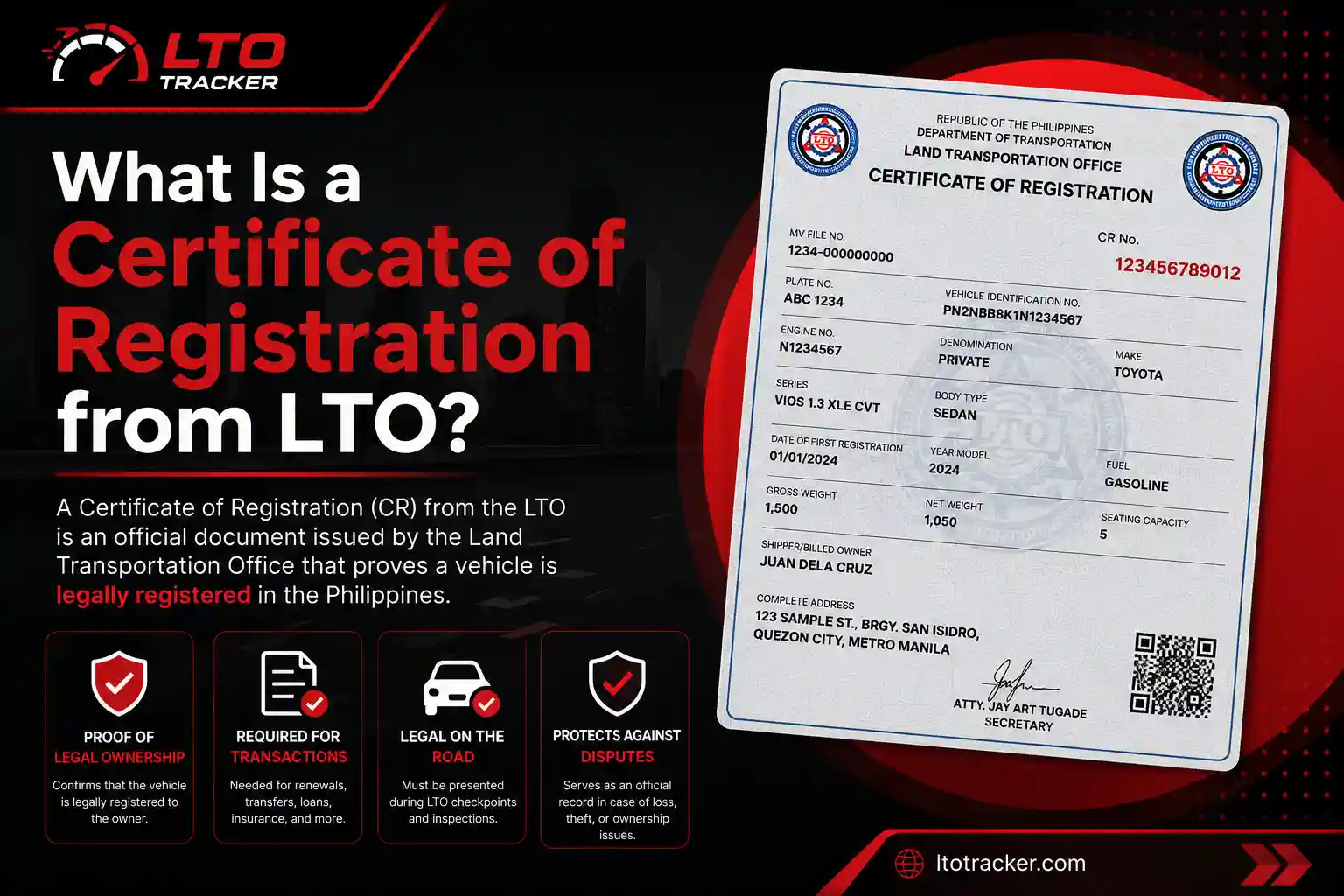
The certificate of registration is your official proof that a vehicle is registered with the LTO and authorized to operate on Philippine roads. It contains important details like your name, plate number, vehicle type, engine number, and registration expiry date.
You receive this document after completing vehicle registration. It comes paired with the Official Receipt (OR). Together, they’re called CR/OR.
Many vehicle owners confuse the CR with the Official Receipt (OR), but they serve different purposes. While the OR proves that registration fees have been paid, the CR contains the official details of the vehicle and its registered owner.
Over 12 million vehicles operate in the Philippines today. Each one needs this document. Without it, you can’t legally drive on public roads.
Think of it like your vehicle’s birth certificate. Police officers, insurance companies, and LTO offices will ask for it. Keep it in your vehicle at all times.
What Information Does It Show?
Your registration certificate displays:
- Owner’s full name and address
- Plate number and MV file number
- Make, model, and year of manufacture
- Engine number and chassis number
- Classification (private, commercial, motorcycle)
- Registration expiry date
- Encumbrance status if financed
The document includes security features like holograms and watermarks. These prevent counterfeiting.
How to Get an LTO Certificate of Registration?
The process of getting a Certificate of Registration depends on whether the vehicle is brand new, imported, or previously owned. In most cases, the CR is issued after the vehicle has been successfully registered with the LTO.
Step 1: Prepare Your Documents
Before visiting the LTO office, gather all the required documents. These may include proof of ownership, valid identification, insurance documents, and other registration requirements.
Step 2: Visit the LTO Office
Go to the LTO office that handles vehicle registration. Make sure to bring both the original documents and photocopies if required.
Step 3: Submit Your Documents
Submit all required documents to the LTO personnel for review and verification. The staff will check your information and ensure that all requirements have been completed.
Step 4: Vehicle Inspection
During the inspection, the LTO may verify important details such as the engine number, chassis number, and the overall condition of the vehicle.
Step 5: Pay the Fees
Once your documents have been approved, pay the required registration fees.
Step 6: Get Your CR
After the registration process is completed, the LTO will issue your Certificate of Registration (CR). You will also receive an Official Receipt (OR) as proof of payment.
For Brand-New Vehicles
When you purchase a brand-new vehicle from a dealership, the dealer usually handles the initial registration process on your behalf.
Once registration is completed, the LTO issues the vehicle’s Certificate of Registration.
Documents Usually Required
The dealer submit the following documents:
- Sales invoice
- Certificate of Stock Reported (CSR)
- Vehicle insurance documents
- Taxpayer Identification Number (TIN), if applicable
- Other registration requirements required by the LTO
After processing, the owner receives the CR along with other registration documents.
For Imported Vehicles
Imported vehicles require additional documentation before registration.
These documents include:
- Customs clearance papers
- Importation documents
- Proof of ownership
- Vehicle inspection reports
- Insurance documents
The LTO verifies these records before issuing a Certificate of Registration.
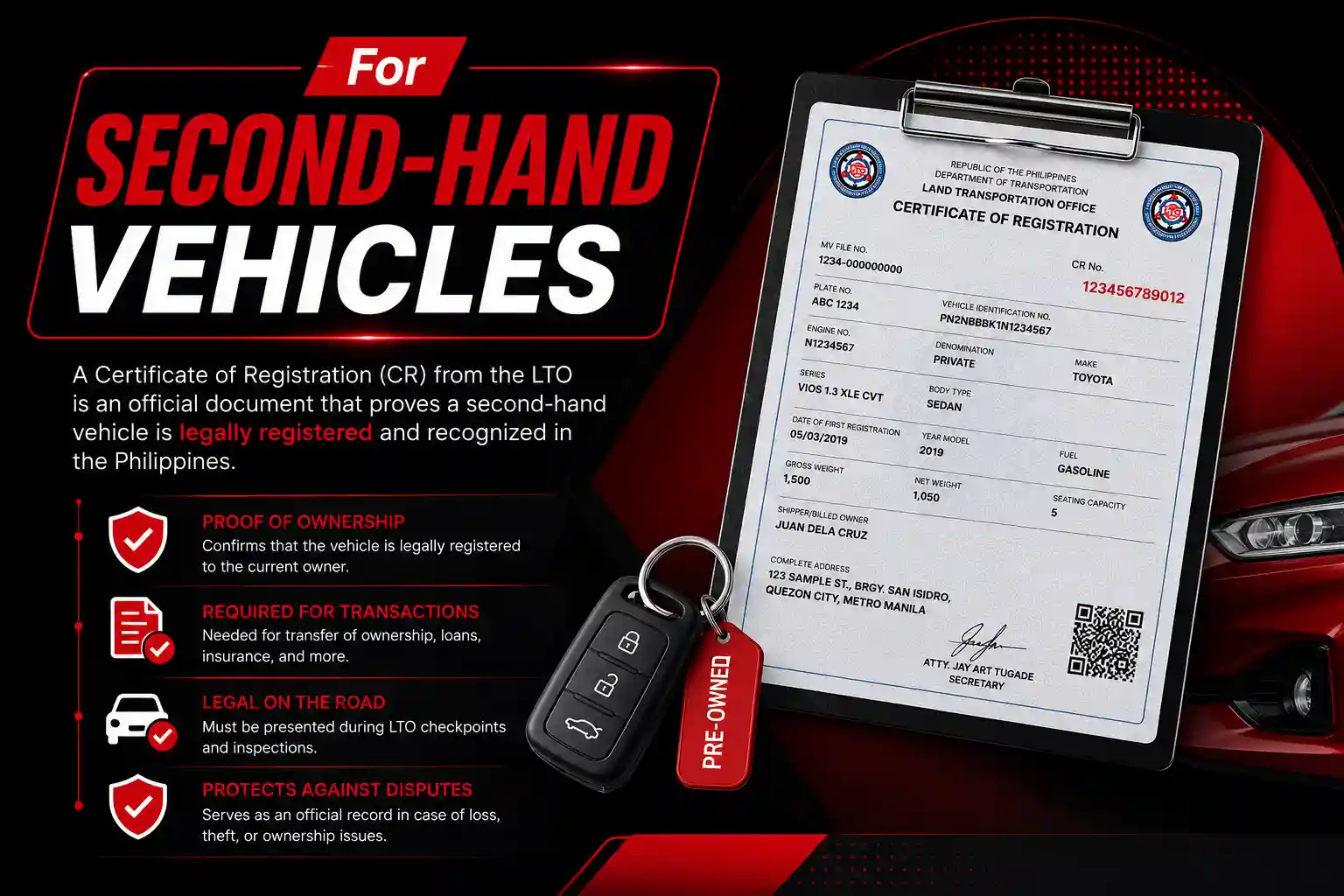
For Second-Hand Vehicles
If you purchase a used vehicle, the existing CR must be transferred to your name.
The transfer process involves:
- Verifying vehicle ownership.
- Completing the deed of sale.
- Submitting transfer requirements.
- Updating LTO records.
- Receiving a new CR under the buyer’s name.
How to Get a Certificate of Registration for Motorcycle?
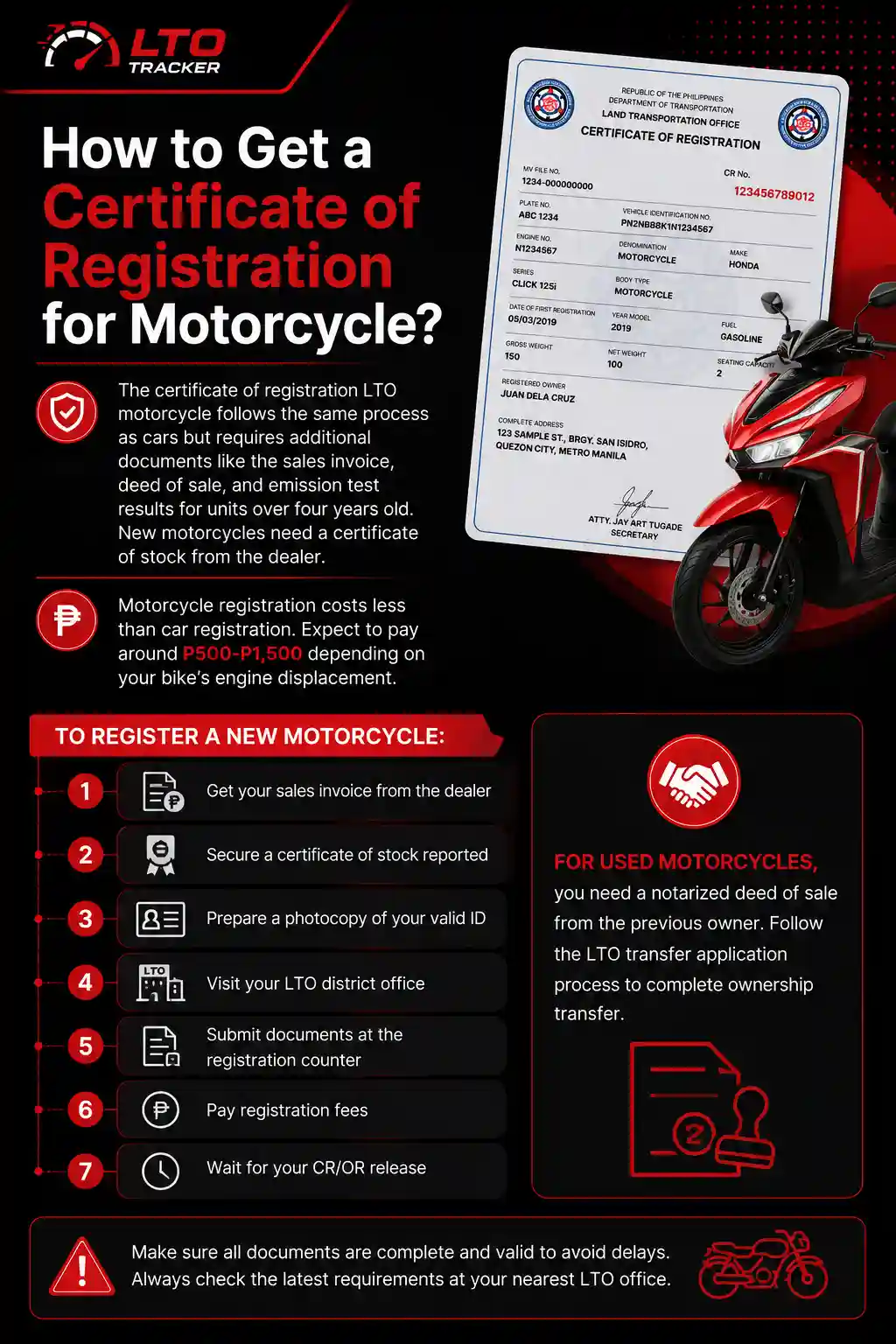
The certificate of registration LTO motorcycle follows the same process as cars but requires additional documents like the sales invoice, deed of sale, and emission test results for units over four years old. New motorcycles need a certificate of stock from the dealer.
Motorcycle registration costs less than car registration. Expect to pay around P500-P1,500 depending on your bike’s engine displacement.
To register a new motorcycle:
- Get your sales invoice from the dealer
- Secure a certificate of stock reported
- Prepare a photocopy of your valid ID
- Visit your LTO district office
- Submit documents at the registration counter
- Pay registration fees
- Wait for your CR/OR release
For used motorcycles, you need a notarized deed of sale from the previous owner. Follow the LTO transfer application process to complete ownership transfer.
How to Check Your LTO Certificate of Registration Status?
You can track your certificate of registration LTO through the official tracker at lto.gov.ph or through our tracking services that access the same LTO database. You need your MV file number or plate number to check status.
If you are waiting for your Certificate of Registration (CR), there are several ways to check its status. You can use online services, check with your MV file number, or visit an LTO office for assistance.
The certificate of registration lto tracker shows whether your document is being printed, dispatched to your LTO office, or ready for pickup.
For step-by-step tracking instructions, check this complete tracking guide that walks you through the entire process.
Check Through the LTMS Portal
The Land Transportation Management System (LTMS) Portal is the way to view your registration-related information online.
To check your CR status:
- First access to your LTMS account.
- Go to the vehicle information or registration section.
- Look for your vehicle’s registration details.
- Check whether the registration has been processed and recorded in the system.
This method is convenient because you can check your registration status anytime without visiting an office.
Check Using Your MV File Number
Your MV (Motor Vehicle) File Number is a unique identification number assigned to your vehicle.
To check your CR status follow the instructions:
- Locate your MV File Number from your registration documents or official receipt.
- Contact the LTO through its hotline, email, or customer service channels.
- Provide your MV File Number when requested.
- Ask for the latest update regarding your Certificate of Registration.
The MV File Number helps LTO staff quickly find your vehicle records.
Visit an LTO Office
If online methods do not provide enough information, you can visit the LTO office where your vehicle was registered.
Bring the following documents:
- Valid government-issued ID
- Official Receipt (OR)
- MV File Number (if available)
An LTO representative can check the status of your registration and inform you if your CR is ready for release.
Common Reasons for Delayed CR Release
Several factors may cause delays in the release of a Certificate of Registration:
- Incomplete or incorrect registration documents
- Pending verification of vehicle records
- System maintenance or technical issues
- High volume of registration transactions
- Unpaid fees or unresolved registration requirements
If your CR is delayed, contact the LTO or visit the registration office to determine the exact reason and learn what steps are needed to resolve the issue.
Tracking Methods Compared
| Tracking Methods Compared | Speed | Accuracy | Cost |
|---|---|---|---|
| LTMS Portal | Real-time | Official source | Free |
| SMS Inquiry | 1-2 hours | Moderate | P2.50 per text |
| LTO Office Visit | Instant | Most accurate | Transportation cost |
| Third-party Trackers | Real-time | Good | Free |
Why Does the LTO Issue a Certificate of Registration?
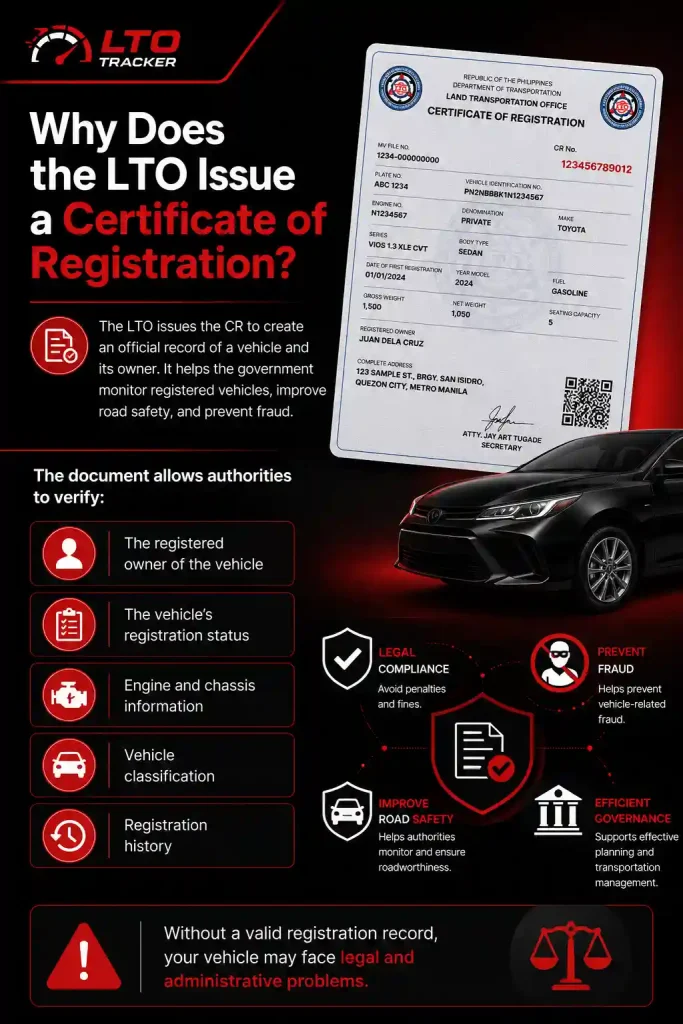
The LTO issues the CR to create an official record of a vehicle and its owner. It helps the government monitor registered vehicles, improve road safety, and prevent fraud.
The document allows authorities to verify:
- The registered owner of the vehicle
- The vehicle’s registration status
- Engine and chassis information
- Vehicle classification
- Registration history
Without a valid registration record, your vehicle may face legal and administrative problems.
Importance of the Certificate of Registration
The CR is more than just a registration document. It is required for many vehicle-related transactions and legal procedures.
Some of its main purposes include:
- Proving vehicle ownership
- Renewing registration
- Selling a vehicle
- Transferring ownership
- Applying for insurance claims
- Verifying vehicle information
- Passing vehicle inspections
Because of its importance, as a vehicle owner you should keep the original document in a safe place. Many vehicle owners only realize the importance of the CR when they lose it or need it for a transaction. However, the document plays an important role throughout the life of a vehicle.
- Proof of Registration
The CR serves as official proof that the vehicle has been registered with the LTO.
Without registration, a vehicle may not be legally operated on public roads.
- Needed for Vehicle Sales
When selling a vehicle, the buyer will usually ask for the original Certificate of Registration. Because the document helps verify that the seller is the legitimate registered owner and that the vehicle information is accurate.
- Required for Transfer of Ownership
Ownership cannot be properly transferred without the CR. The LTO uses the document to update records and register the vehicle under the new owner’s name.
- Useful During Traffic Inspections
Traffic enforcers may request vehicle documents during checkpoints or inspections. Having the correct registration documents can help avoid delays and verification issues.
- Important for Insurance Claims
Insurance companies often require proof of vehicle ownership and registration before processing claims. The CR is one of the documents commonly requested during this process.
Certificate of Registration LTO Validity
Your LTO certificate of registration is valid for one, two, or three years depending on your vehicle type and chosen registration period. Most private vehicles now use the three-year registration cycle.
For motorcycles and cars under the three-year program, you renew every three years. Commercial vehicles still follow annual registration. Your expiry date appears on the certificate itself.
Set a phone reminder three months before expiry. This gives you time to prepare documents and avoid last-minute rushes.
LTO Certificate of Registration Expiration
There’s no official grace period. Once your CR expires, your vehicle becomes unregistered. Driving with an expired registration leads to fines and potential impounding.
You can renew up to 90 days before your expiry date. Take advantage of this early renewal window.
How to Access Your LTO Certificate of Registration Online?
If you want to access your CR online without visiting the LTO office then you can access the official portal website. It is part of the Land Transportation Management System (LTMS) accessible through the official LTO website at lto.gov.ph. You need to create an account first before tracking or downloading your certificate.
Through the portal you can check registration status, view digital copies, and also schedule appointments whenever you need. It replaced the old manual system.
To get access to the LTO system via its portal website you must check our complete portal registration/login guide. Through this guide you will easily create your account and connect yourself to the LTO system.
After accessing the portal you must register your vehicle plate number on the portal to see your vehicle registration details. The system updates daily with new information from LTO offices nationwide.
Certificate of Registration LTO Sample
A certificate of registration sample shows the standard format including security features, vehicle details, owner information, and official LTO seals that you should verify on your actual document. The physical size is approximately 8.5 x 13 inches printed on security paper.
The document has a white background with blue and red security patterns. At the top, you’ll see the LTO logo and “Republic of the Philippines” text.
Key sections include:
- Header with document title and series number
- Vehicle identification section (left side)
- Owner information section (right side)
- Registration validity dates (bottom)
- Authorized signatures and official seal
The Certificate of Registration LTO Size
The LTO CR size is letter-size but slightly longer. It fits standard document holders but sticks out slightly.
Laminate your certificate to protect it from wear and tear. But keep the original unlaminated copy at home as a backup.
Requirements for Duplicate Certificate of Registration LTO
The requirements for duplicate CR include a notarized affidavit of loss, valid ID, OR of registration fees, certified true copy of the OR/CR, and police report if the document was stolen. Processing takes 3-5 working days at most LTO offices.
If you have lost your certificate, don’t panic! The LTO issues duplicates for P350 plus other processing fees.
Here’s what you need:
How to Request a Copy
To get a copy of your CR, you will need to:
- Visit the LTO office where your vehicle records are available.
- Present a valid government-issued ID.
- Provide your vehicle details, such as the plate number or MV file number.
- Submit any additional documents requested by the LTO.
- Pay any applicable fees, if required.
Note: If you have lost your original Certificate of Registration, you cannot simply request a photocopy. Instead, you will need to apply for a replacement CR by submitting the required documents, including an Affidavit of Loss and valid identification.
How Long It Takes to Receive a Duplicate CR
Most offices release duplicates within three to five working days. Some busy districts like Quezon City and Manila may take up to two weeks.
Note: You can check your application progress via above mentioned methods.
How to Replace a Lost LTO Certificate of Registration
If you lose your CR, you can encounter problems when renewing registration, transferring ownership, or proving vehicle registration.
Fortunately, the document can be replaced through the proper LTO process.
Requirements for Lost CR Replacement
The exact requirements vary depending on the LTO office, but commonly requested documents include:
- Affidavit of Loss
- Valid government-issued ID
- Official Receipt (OR), if available
- Other supporting documents requested by the LTO
It is best to prepare both original documents and photocopies before visiting the office.
Step-by-Step CR Replacement Process
Visit a notary public and obtain an Affidavit of Loss explaining how the document was lost. The affidavit serves as your official declaration regarding the missing CR.
Go to the LTO office where the vehicle’s records are available or where the transaction can be processed. Bring all required documents.
Present your documents to the assigned personnel for verification. The office review ownership records and vehicle information before processing the request.
Replacement fees depending on the transaction and current LTO regulations. Keep all official receipts for reference.
Once approved, the LTO will issue a replacement Certificate of Registration. Review the document carefully before leaving the office to make sure all information is correct.
How to Replace a Damaged Certificate of Registration
A CR that is torn, faded, burned, or otherwise damaged should be replaced as soon as possible.
Damaged documents can become difficult to read and can cause issues during inspections or transactions.
Common Reasons for Replacement
- Torn pages
- Water damage
- Faded printing
- Missing sections
- Illegible information
Replacement Procedure
The process is similar to replacing a lost CR.
Vehicle owners need to submit:
- The damaged original CR
- Valid identification
- Supporting vehicle documents
- Applicable fees
After verification, the LTO issues a replacement document.
How Much Does Registration Renewal Cost?
Registration renewal costs vary by vehicle type, with private cars paying approximately P1,200-P2,500 and motorcycles paying P500-P1,200 including all fees for single-year registration. Three-year registration multiplies these amounts by three.
Here’s a list of costs according to the vehicle type:
| Vehicle Type | 1-Year Cost | 3-Year Cost |
|---|---|---|
| Motorcycle (up to 400cc) | P500-P800 | P1,500-P2,400 |
| Motorcycle (above 400cc) | P800-P1,200 | P2,400-P3,600 |
| Private Car | P1,200-P1,800 | P3,600-P5,400 |
| SUV / Van | P1,800-P2,500 | P5,400-P7,500 |
These amounts include registration fee, plate fee, MV file fee, sticker fee, and other charges. Prices increase for heavy vehicles.
What Happens If I Drive Without Valid Registration?
Driving without a valid CR is a violation of Republic Act 4136 and results in fines ranging from P3,000 to P5,000 plus possible vehicle impounding. Repeat offenders face higher penalties.
Traffic enforcers check your CR during routine stops. If it’s expired or missing, they issue a violation ticket.
Consequences include:
- P3,000 minimum fine for expired registration
- Vehicle impounding until you settle fines
- Court appearance for unregistered vehicles
- Points added to your driving record
- Insurance claims may be denied
To check if you have pending violations, view traffic violations online before renewal. Settle these first to avoid processing delays.
Information Found on an LTO CR
The Certificate of Registration contains important details about both the vehicle and its owner.
| Section | Details Included | Purpose |
| Owner Information | Full name of the registered ownerRegistered addressOwner classification | Identifies the person or entity legally responsible for the vehicle. |
| Vehicle Information | Plate numberMV file numberEngine numberChassis numberVehicle makeVehicle modelVehicle colorVehicle typeFuel typeVehicle classification | Provides technical and identification details used by the LTO and law enforcement agencies to verify the vehicle. |
| Registration Information | Registration numberDate of registrationRegistration statusIssuing office | Confirms that the vehicle is officially registered and recorded in the LTO registration system. |
Difference Between LTO OR and CR
Many motorists mistakenly believe that the Official Receipt (OR) and Certificate of Registration (CR) are the same document. They are not!
Each document serves a different purpose.
| Feature | Official Receipt (OR) | Certificate of Registration (CR) |
|---|---|---|
| Purpose | Proof of payment | Proof of vehicle registration |
| Issued By | LTO | LTO |
| Shows Vehicle Details | Limited | Yes |
| Shows Owner Information | Limited | Yes |
| Required for Ownership Transfer | No | Yes |
| Used for Registration Verification | No | Yes |
Official Receipt (OR)
The Official Receipt is issued after payment of registration fees. It serves as proof that the required registration fees have been paid to the LTO.
Certificate of Registration (CR)
The Certificate of Registration contains the official registration record of the vehicle. It identifies the vehicle, shows owner information, and serves as proof that the vehicle has been officially registered.
Why You Should Keep Both Documents?
The OR and CR work together as supporting registration documents.
When you have available both documents, it can make your vehicle transactions easy and avoid problems during inspections, registration renewals, and ownership transfers.
For safety, keep photocopies or digital copies while storing the original documents in a secure location.
How to Verify an LTO Certificate of Registration?
Verifying a Certificate of Registration is important, especially when purchasing a second-hand vehicle.
A proper verification helps confirm that the vehicle details match official records.
- Check the Vehicle Information
Compare the information on the CR with the actual vehicle.
Verify the following:
- Plate number
- Engine number
- Chassis number
- Vehicle make and model
- Vehicle color
Any mismatch should be investigated before completing a purchase.
- Verify Ownership Details
Review the registered owner’s name and address. Make sure the seller is the same person listed on the CR or has legal authority to sell the vehicle.
- Inspect the Original Document
Always request the original CR.
Be cautious of:
- Blurred printing
- Altered information
- Missing security features
- Visible corrections or erasures
A genuine CR should contain consistent and accurate information.
- Confirm Through LTO Records
If you have concerns about a vehicle’s registration status, you have to visit an LTO office and request verification based on available procedures. Due to this step you can confirm whether the registration information is valid and current.
How to Update Information on a Certificate of Registration?
You should make sure that the information on their CR remains accurate. Because incorrect records can create problems during your registration renewals, inspections, and even ownership transfers.
If any details on your CR are incorrect or have changed, you should update them through the LTO.
Change of Ownership
If you sell your vehicle or transfer it to another person, the ownership information on the CR must be updated.
The new owner needs to submit the required documents to the LTO so the vehicle can be registered under their name. Once approved, the LTO will issue a new CR showing the new owner’s details.
Updating ownership is important because the previous owner may still be held responsible for violations if the transfer is not completed.
Change of Address
If you move to a new home, you should update the address listed on your CR.
Having the correct address helps keep your vehicle records accurate and ensures you receive important notices related to your vehicle.
Correction of Name
If your name is misspelled on the CR, you should request a correction as soon as possible.
Even a small spelling mistake can cause delays when processing vehicle transactions or verifying ownership.
Engine Replacement
If your vehicle gets a new engine, the engine number on your CR must be updated.
The LTO may ask for documents and inspect the vehicle to confirm the new engine details before updating the records.
Chassis Number Correction
The chassis number is a unique number used to identify your vehicle.
If the chassis number on your CR is incorrect, you should have it corrected immediately. The LTO may inspect the vehicle to verify the correct number.
Vehicle Color Change
If you permanently repaint your vehicle, you may need to update the color listed on your CR.
The color on the registration record should match the actual color of the vehicle.
Simple Steps to Update CR Information
Updating information on your CR is a simple process:
- Prepare the required documents.
- Visit the nearest LTO office.
- Submit your request for correction or update.
- Allow vehicle inspection if required.
- Pay the necessary fees.
- Receive your updated Certificate of Registration.
Before leaving the LTO office, carefully check your updated CR. Make sure your name, address, engine number, chassis number, and other vehicle details are correct.
Keep your CR information updated to avoid problems and also make your future vehicle transactions easy.
Common Problems Related to LTO Registration Certificates
Vehicle owners experience issues involving their Certificate of Registration. When you have complete understanding about common problems you can resolve them quickly. So we are discussing here some of the most frequently occurring issues along with their possible solutions.
- Lost Certificate of Registration
A lost CR is one of the most common issues. Without the document, ownership transfers and registration-related transactions become more difficult for you.
The best solution is to apply for a replacement as soon as possible.
- Damaged Certificate of Registration
CR documents can become damaged due to:
- Water exposure
- Fire damage
- Accidental tearing
- Fading caused by age
You must replace it because replacing a damaged document remain all information readable.
- Incorrect Information
Mistakes can occasionally appear on registration documents.
Examples include:
- Incorrect name spelling
- Wrong engine number
- Wrong chassis number
- Incorrect address
You should correct these errors immediately to avoid future complications.
- Delayed Issuance
Some vehicle owners experience delays when waiting for registration documents.
Delays occur because of:
- Incomplete requirements
- Verification issues
- System maintenance
- High transaction volumes
So follow up with the appropriate office to determine the status of your request.
- Mismatched Vehicle Information
The information on the CR should always match the actual vehicle.
Any discrepancy involving the engine number, chassis number, or plate number should be investigated immediately.
How to Protect Your CR
Because the CR is an important legal document, proper storage and handling are necessary.
- Store the Original in a Safe Place
Keep the original document in a secure location at home where it is protected from theft, fire, and water damage. Avoid leaving the original CR inside the vehicle for extended periods.
- Keep Photocopies
Maintain several photocopies of the document. These copies can be useful when completing transactions that do not require the original document.
- Create Digital Backups
Scan the CR and store digital copies in secure locations such as:
- Personal computer
- Cloud storage
- External drive
Digital backups can make replacement procedures easier if the original is lost.
- Check the Document Regularly
Review your CR periodically to make sure:
- Information remains accurate
- The document is not damaged
- All pages remain readable
Early detection of problems can prevent larger issues later.
Frequently Asked Questions


Final Thoughts
The LTO Certificate of Registration is one of the most important documents a vehicle owner can possess. It serves as official proof that a vehicle has been registered and contains important information about both the vehicle and its owner.
Whether you are buying a car, selling a motorcycle, renewing registration, or transferring ownership, the CR plays a critical role in the process. By understanding how the Certificate of Registration works, vehicle owners can complete transactions more smoothly and stay compliant with LTO requirements.